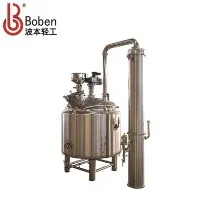
Effect of Copper on Stills
During the distillation process, it is not difficult to find that copper stills have functional advantages over stainless steel stills in removing impurities and optimizing aroma. When fruit wine is distilled into brandy, the aroma of the spirit distilled in a copper still is more natural and pure, and the fruity aroma is delicate and elegant; when whiskey is distilled from grains, the aroma of the spirit distilled in a copper still is also more pure and harmonious than that of a stainless steel still, while stainless steel Spirits distilled from the material often have a meat-like aroma. For raw wine that contains a small amount of sulfur, the spirits distilled from stainless steel stills have a sulfur smell. Sometimes, copper stills can be used to reduce the sulfur smell. This phenomenon also reflects that copper stills have a certain effect in removing sulfur smells.

Common off-flavors come from sulfides. According to research, among various sulfides, trisulfide (DMTS) has a dominant influence. Its sensory threshold is about 0.1 μg/L, or the concentration in new spirit. About 1~6 micrograms/liter. According to research, when copper and stainless steel stills are used, only DMTS produces significant differences among various sulfides.
However, not all copper has the same effect. For example, in the experiment with glass stills, adding copper salt (cuprous chloride) will increase the content of DMTS, while adding copper mesh will reduce the effect of used copper stills. It is better than new products, and even other metal ions in the spirit juice will have an impact. Copper's catalytic action converts thiols into less pungent carbonyl groups.
A team conducted experiments on the impact of copper in different parts of the still on the style of distilled wine. Taking the whiskey still as an example, the wine juice and spirits still were disassembled into six parts and replaced with stainless steel respectively. Before replacement, all-copper and all-stainless steel stills were used for sensory qualitative analysis, which showed that the all-copper stills were The distiller can indeed remove unpleasant sulfur, meat and other impurities and make it appear cleaner.

In the production of Scotch malt whiskey and French Cognac, the use of copper in the stills used for distillation is considered to play an important role in the aroma of the distilled spirits. This experiment showed that copper is more effective in some parts of a pot still than others. This information can be used to help with still design and maintenance, such as the style of the still, the degree of copper loss in the still, etc.
Nowadays, many wineries in China have begun to experiment with still types and materials. For example, well-known Chinese liquor distilleries will use Charente-style stills used for traditional brandy for distillation; some people have added copper purification balls, goosenecks and condensers to the design of traditional liquor stills; and many distilleries in the United States The copper stills for whiskey or brandy will be replaced with stainless steel, and removable copper plates will be prepared for the stills.