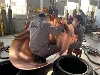
An important part of whiskey production is distillation. Distillation is actually the process of extracting ethanol and trace components in the mash through heating. The size and shape of the still during distillation, and the timing of cutting the heart of the wine will all affect the flavor of whiskey. In addition, the heating method during distillation will also affect the flavor of whiskey.

"Direct fire heating" at the Yoichi (NIKKA) distillery (picture from the Internet)
In ancient times, people lit a fire under the still to directly heat the still, similar to the firewood stove in rural areas. This method was called "direct fire heating". The fuels used in the early days were wood, coal, peat, etc., and later Most are converted to natural gas.
Around the 1960s, most distilleries no longer used "direct fire heating" and switched to "indirect heating" (the first company to use the "indirect heating" process was Glenmorangie, which was 1887). The most common "indirect heating" is "steam indirect heating", that is, a steam pipe is installed inside or outside the distiller, a central boiler is used to heat water to generate steam, and then the steam is transported to the steam pipe to exchange heat with the inside of the distiller. Heat the sake mash. In addition, there is "water bath heating". As the name suggests, the bottom of the distiller is placed in hot water for heating, similar to cooking. Nowadays, most Scottish distilleries use "indirect heating". Only three distilleries, Glenfarclas, Glenfiddich and Springbank, still use "direct fire heating". Many distilleries in Japan still maintain the "direct fire heating" process.

Steam pipe inside the distiller (picture from the Internet)
Why do most distilleries no longer use "direct fire heating"? The reason is that "direct fire heating" is costly and difficult to operate. When using the "direct fire heating" process, the still has to withstand strong fire heating, and the pot wall must be thicker. The wall of the "direct fire heating" still may be 10mm thicker than the "indirect heating" still; and the distilled mash It is mushy and easily sticks to the bottom and inner wall of the distillation kettle when heated by direct fire. Therefore, a scraper must be installed in the distillation kettle using the "direct fire heating" process to scrape off the starch stuck to the inner wall. When scraping off the starch, it is inevitable that the copper on the still kettle will be scraped off, so the consumption of the still kettle will be large. In addition, if the "direct fire heating" heat is not controlled well, the starch stuck to the inner wall of the distillation pot will be burned, which will give the wine an unharmonious burnt taste.

Scraper (picture from the Internet)
Doesn't "direct fire heating" have any advantages? no. "Direct fire heating" can reach higher temperatures. It is said that the temperature of "direct fire heating" can reach more than 650°C, while indirect heating can only reach 130°C. A series of complex reactions will occur during high-temperature heating (such as "virtue" Pull reaction", which will produce the flavors of chocolate and caramel), providing the original wine with complex flavors of caramel, chocolate, nuts, etc. Generally speaking, whiskey that uses the "direct fire heating" process usually has a "heavier body" and a complex, rich flavor. Because of this, distilleries that want to maintain traditional flavors still use "direct fire heating" The most typical example of the technology is Glenfarclas. In 1981, Glenfarclas changed the "direct fire heating" to "steam heating". After the transformation, it was found that the new wine tasted relatively bland and could not even withstand long-term aging. Therefore, another Change back to "direct heat".