As a whiskey drinker, when you are in a professional tasting meeting, a group of drinkers, a whiskey bar, and face the high-pitched talk of the professional drinkers around you, is there such a thing? Because I didn't have a deep understanding of whiskey, I couldn't pick up the accent and speak calmly. In the end, I was annoyed that even though I was holding a glass of high-value wine, there were so few topics to discuss whiskey that I had no choice but to talk. Can you passively listen to other people's boasts throughout the whole process?

Therefore, this guide aims to provide whiskey drinkers with a brief introduction to some trivia about whiskey in case they need it from time to time. You are welcome to take whatever you need. If it helps, we will be honored.

This article will start with the production process of Scotch whiskey and slowly reveal another layer of Scotch whiskey.
1. Making your own wheat is the feeling and style. Purchasing is nothing - hey ~ the most fragrant ~
Three Monkeys (Monkey Shoulder) Whiskey is a pure malt blended whiskey that is extremely easy to find in bars. Its literal English translation should be "Monkey Shoulder". This word actually comes from the traditional artificial malting method, because workers have to bend over for many years. Turning wheat by hand made me so tired that my hands drooped and I walked rickety during rest, hence the nickname for myself.

This traditional artificial malting method is a type of floor malting. The soaked grains are spread out on an impermeable stone slab or cement floor, and experienced workers use shovels to open up the wheat pile and scatter it. The heat generated during germination is called floor malting. Today in Scotland, only a handful of whiskey distilleries still retain this malting method, such as Springbank, Abhainn Dearg, Bowmore, Kilchoman, and Highland Knight. Highland Park, Laphroaig, Balvenie and BenRiach. Today, during tours of the Balvenie distillery, there is still a demonstration of the floor malting process.

With the continuous advancement of industrial machinery, in order to reduce costs and increase efficiency, starting in the 1960s, most whiskey distilleries gradually gave up the floor malting process and began to introduce the Saladin Box. The principle is to use a In a large box, a device is installed that uses mechanical drive instead of manual wheat turning. In addition to saving manpower, the key point is that the wheat yield is larger and more efficient, the germination process is more stable, and the space required is also greatly reduced.

However, a new technology quickly emerged, that is, the Pneumatic Drums Malting System. Its principle is also very simple. The drum rotates automatically after the grains are poured into the circular container to achieve the turning effect. , and the drum is equipped with constant temperature and exhaust functions to control the environmental impact of malting and stabilize malt quality.

Today, floor malting, Saladin box malting and drum malting are the three most common malting methods. However, the Scotch whiskey industry has discovered another more convenient path: instead of malting, just do it directly Buy~

"Professional things should be done by professional people" is also applicable in today's Scotch whiskey industry: barley malting should be completed by specialized manufacturers, which will be more conducive to whiskey quality control.
Nowadays, many Scotch whiskey distilleries choose to purchase malt directly from malting factories to reduce costs and increase efficiency. There are also whiskey distilleries that have turned into malting factories under the operation of liquor industry groups after closure, such as the famous Ai The Isle of Thunder winery, Port Ellen, has been shut down. The drum system used for malting is the largest malting drum in the UK and even Europe. In addition to supplying the Lagavulin and Caol Ila distilleries of the same group, its malts are also supplied to Ardbeg, Bowmore, Bunnahabhain and Talisker. ) and Tobermory are also its customers. However, due to the launch of the distillery's production resumption plan in recent years, it is expected that its external supply of peated malt may be significantly reduced or even completely cut off.

2. Maybe we are baking bread?
Has anyone noticed that the logo of Cardhu whiskey is a woman waving a flag?

This has something to do with Helen Cumming, the wife of distillery founder John Cumming. The Cummings had been producing illegal, small-scale whiskey on their family's farm in Cardew for 13 years before Scotland issued distillery licenses under the Excise Act of 1823.
Although John was convicted of illegal distilling three times without an official license during this period, until the distillery officially obtained a license in 1824, relying on Helen's brewing skills and tax avoidance skills, the moonshine brewing at Cardew Farm never stopped.

The so-called tax avoidance technique is due to the fact that Caddu Farm is located south of Glen Canyon, an outpost where moonshiners gather. The entire area is like a basin, and Caddu Winery is higher on the hillside. Whenever the tax collectors passed by the farm and smelled the aroma produced by the mashing and development of whiskey, Helen would lie and say that the mashing and fermentation were making bread, and invited the tax collectors to sit down and entertain them with bread and tea to delay time and go to the barn to refine the whiskey. Raise a red flag to other moonshiners.

For whiskey distilleries, saccharification and fermentation are a key step in producing whiskey. Andrew Thompson, founder of Wolfburn, believes that it only takes about 4 months to learn about the distiller after working in a distillery. Everything, but regarding mashing, it takes at least 2 years.

In fact, after the barley or grains are malted, the next step is saccharification of the crushed malt produced by the malt mill. The crushed malt and hot water are put into the mash tun (mash tun) in a certain ratio, stirred, washed, and Filtration and finally filtration to obtain "wort", which simply means soaking the crushed malt in a hot bath.

The largest mash trough in Scotland is the Bunnahabhain mash trough, which is also a traditional roofless open cast iron or iron cracked cylinder mash trough. Currently, in addition to Bunnahabhain, there are still Bunnahabhain mash troughs. Used by a few Scottish distilleries such as Bruichladdich, Springbank, Deanston and Royal Lochnagar.

Fermentation after mashing is the key to shaping the flavor of whiskey. Under normal whiskey fermentation conditions, generally speaking, after 48 to 50 hours, the yeast will produce alcohol, and the distilled spirit will have a grain flavor. Fermentation that lasts for more than 60 hours takes advantage of the dormant period when the yeast is dormant. At this time, there will be New flavors, resulting in more complex spirits.
Therefore, from the perspective of fermentation time, most of the Scotch whiskey industry uses about 48-50 hours as the dividing line for fermentation time. Below 50 hours is considered short fermentation, 60 to 75 hours is considered average fermentation time, and 75 to 120 hours It is considered to be long fermentation. Nowadays, more and more wineries are also considering delaying the fermentation time to change the flavor of the wine when improving the process. For example, the fermentation time of Bladnoch Winery is up to 127 hours.

Nowadays, in order to comply with the two-day holiday rule, some Scotch whiskey distilleries allow the whiskey to ferment for two more days when no one is working on Saturday or Sunday, and then distill the juice until they are working on Monday. Therefore, the distillery is open to the public. The fermentation time range may fall between 48 and 96 hours, which is the so-called weekend fermentation.

Judging from the material of the fermentation tank, most common fermentation tanks nowadays are made of stainless steel, or a combined fermentation tank with a stainless steel top cover based on a wooden tank, while traditional fermentation tanks are made of European pine. . Of course, there are also cases where lark, cypress, or even Mizunara wood are used to make fermentation tanks. Japan's Chichibu Distillery is the only whiskey distillery in the world that uses Mizunara wood fermentation tanks.

3. Distillation: Ireland cannot be avoided
There is no accurate record in history as to when whiskey distillation began. But the more widely circulated theory is that whiskey originated from an accidental alchemy obtained by Irish monks in the Middle Ages, but this statement is highly controversial.

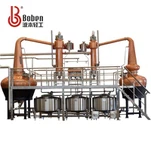
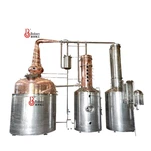
Historically, the materials of whiskey stills have been constantly changing. In the ancient times when whiskey was still called water of life (aquavitae), stills were basically made of clay pots with a small capacity. However, with the development of alchemy, this gradually changed. Materials include tin, gold, brass and copper. Today's whiskey stills are basically made of copper or stainless steel.

The shape of the still is basically divided into Pot Stills and Column Stills. Tower stills in the whiskey industry are dominated by Coffey stills, which have the characteristics of continuous distillation and strong distillation and purification capabilities. Therefore, tower stills are not only used in the whiskey industry, but their principles and structures are also It is also widely used in other chemical industry fields and is called a distillation tower.

Of course, it goes without saying that pot stills are used. According to Scotch whiskey regulations, single malt whiskey must use pot stills. It is particularly worth mentioning that, in addition to the traditional pot still, the special Lochman still used in Loch Lomond Distillery can be said to be a combination of a pot still and a tower still, but its predecessor The Lomond still was eventually abandoned by various distilleries due to unsatisfactory results, and was unable to become the mainstream of the pot still type.

Although the materials and shapes of distillers have been constantly innovating, the method of distillation has not changed much. In the early 19th century, most distilleries used malt and other grains as raw materials for distillation. However, due to the limitations of production technology, the secondary distillation at that time was faced with the problem of distilling new wine that was pure enough and with a high enough alcohol content. So the origin of The triple distillation technology in Ireland became the mainstream of whiskey production at that time.

This triple distillation technique not only laid the foundation for the flavor and style of Irish whiskey in the future, but also made this kind of purer and sweeter Irish whiskey a hot seller in the market. At the end of the 19th century, as the Irish whiskey market became popular in Scotland and England, distillers in the lowland areas of Scotland began to follow suit. Even at the end of the 17th century, there were four times in some of the outer islands of Scotland. Distillation. Among them, the famous Talisker distillery must be mentioned. Until 1982, it used triple distillation to produce whiskey.

However, with the continuous development of whiskey production technology, distilleries have become more and more mature in controlling the purity of alcohol during the distillation process. In order to retain more flavor during the distillation process, most Scotch whiskey distilleries today still mainly use Double distillation technology. Even Auchentoshan Distillery, which is famous for its 100% triple distillation, has not always used triple distillation in its history. According to Alfred Bernard, the author of "Whiskey Distilleries of the United Kingdom", he visited the distillery in 1887. The records of the factory found that Auchentoshan Distillery had switched to double distillation technology at that time, and then did both double and triple distillation in the early 20th century. Only after the distillery was rebuilt in 1969, it still uses 100% distillation technology. triple distillation technology.