Some time ago, drinking friends were chatting in an exchange group about the craftsmanship of whiskey and liquor. Some drinkers mentioned that the craftsmanship of whiskey is complicated, while others said that the craftsmanship of liquor is complicated. Which one is more complicated, whiskey or liquor?
To clarify this issue, we must first understand the technological processes of whiskey and liquor. There are many classifications of whiskey and liquor. Here we will take the production processes of single malt whiskey and Daqu solid fragrance liquor as examples to briefly introduce the processes of the two.
Let's first take a look at the process of making single malt whiskey. The brewing process of single malt whiskey is roughly divided into six steps: malting, grinding, saccharification, fermentation, distillation and aging.
1. Fattening
Malting is the process of germinating barley to make malt. The purpose of malting is to activate the barley's own amylase during the germination process. Amylase is the saccharifying agent in the subsequent saccharification process. The malting process roughly includes three steps: soaking, germination, and drying. Traditional malting takes about 10 days. The peat flavor in some whiskeys comes from the malting process. Using peat as fuel when drying malt will bring the peat flavor into the whiskey.

Heating is required when malting, so there will be a pagoda-shaped chimney above the roof of the distillery. Nowadays, most distilleries no longer malt themselves, but the image of such a chimney was still retained during construction.
2. Grinding wheat
Grinding the malt means grinding the malt to facilitate later saccharification.
3. Saccharification
Saccharification is to add water to ground malt, and use amylase to hydrolyze the starch polysaccharide contained in the malt into simple sugars (such as glucose, fructose, galactose, etc.). The saccharification process takes approximately 6 hours.

mash trough
4. Fermentation
Fermentation is to add yeast to the saccharified wort, and use the life activities of yeast to convert sugar into alcohol and other trace components such as acids, esters, aldehydes, and alcohols. These trace components are an important part of the flavor of whiskey. Since yeast cannot metabolize polysaccharides, starches must be hydrolyzed into simple sugars before fermentation. The fermentation process usually takes about 60 hours.
5. Distillation
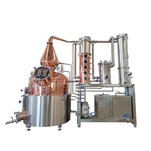
Distillation is the use of a still pot to extract the alcohol and trace components from the fermented mash to increase the alcohol concentration.

still pot
6. Mature
Aging is to put the distilled new whiskey into oak barrels for aging to increase its flavor.

Chinese whiskey oak barrel warehouse

Chinese whiskey
Daqu solid-state light-flavor liquor is a traditional production process of light-flavor liquor. Generally, steaming, burning and secondary clearing are used. The process includes koji making, liquor and grain processing, fermentation, large-crop distillation, re-fermentation, second-crop distillation, and aging. , coordinate the eight links.
1. Make music
The raw materials of fragrant Daqu are barley, peas and water. The production process of Daqu is relatively complicated. Simply put, making koji is to crush the grains, add water and a small amount of koji mother (the Daqu made last time), stir evenly, put it into the koji mold, make the koji block, and then culture it in the koji room ( Inoculate strains (including yeasts, molds, bacteria, etc.), and store them in warehouse after the culture is completed. Generally, they need to be stored for three months before use. The entire koji-making process took nearly a month.
Daqu is a saccharifying agent and an alcoholic agent in the brewing of liquor. The Daqu production process involves a large number of various microorganisms in nature. These rich types of microorganisms are the basis for the rich body of traditional liquor.

Daqu
2. Wine and food processing
The grain used in making light-flavor liquor is sorghum. Liquor-grain processing is to crush sorghum, heat water to moisten it, and then steam it in a steamer (part of the steamed rice bran is also added during steaming to make it fluffy). The steamed wine grains should be left to cool, then the Daqu powder is added, stirred evenly, and placed in a clay vat for fermentation.

The endless sorghum fields in Jinzhong, Shanxi
3. Fermentation
Fermentation is to ferment the wine grains added with Daqu powder in a clay vat. The fermentation time is about 21 to 28 days, or even longer. In the early stage of the fermentation process, alcohol is mainly produced, and in the later stage, aroma and taste are mainly produced. In other words, the longer the fermentation time, the richer the aroma. The fermented grains fermented this time are called big stubble.

fermentation vat
4. Large stubble distillation
The fermented fermented grains are put into a wine steamer for distillation. Unlike the distilling pot used for whiskey distillation, the wine steamer used for liquor distillation is a one-time distillation. In one distillation, a liquor of about 70 degrees can be distilled, and the aroma is very good. The wine distilled this time is called stubble wine.

Distillation, with steamer and barrel in the middle
5. Ferment again
Re-fermentation is to add Daqu powder to the distilled fermented grains and put it into a pottery vat for fermentation again. The fermented grains fermented this time are called the second crop.
6. Second crop wine distillation
The fermented wine grains are distilled in a steamer, and the wine distilled this time is called second crop wine. At this point, a production cycle is completed. A complete production cycle of Daqu solid fragrance liquor takes about two months (excluding koji making).
7. Mature
Maturation means placing the distilled wine in pottery jars or large jars for aging.

The underground wine warehouse of Lu Winery in Changzhi, Shanxi
8. Hook up
The wine distilled from light-flavor liquor is divided into large-crop and second-crop distillations, and the two distillations have their own characteristics. Generally speaking, the first-crop wine is more fragrant and the second-crop wine is richer. Some people compare the first-crop wine to a young girl and the second-crop wine to a young woman. When producing finished wine, first-crop wine and second-crop wine must be blended before they can be used (in the actual production of finished wine, the blending process is more complicated).
From a time perspective, the production cycle of whiskey (excluding aging time) is about 15 days, while the production cycle of Daqu solid-flavor liquor (excluding aging time) is about 3 months. This time does not include If you add the 3 months of Daqu storage time (newly made Daqu cannot be used), the entire production cycle is about 6 months. It can be seen that the production cycle of liquor is much longer than that of whiskey. Whiskey new make is generally not for sale and must be aged in oak barrels. The relevant laws of Scotland require that it be aged in oak barrels for at least 3 years. Single malt whiskeys on the market that are marked with age are generally aged for 10 years. years and above. New liquor cannot be sold directly, and light-flavor liquor generally needs to be stored for more than one year before being sold.
From the previous process introduction, it can be clearly seen that the production process of Daqu solid-flavor liquor is more complex than that of whiskey, and the operation is more complicated than whiskey. Moreover, many processes require manual operation and there are many uncontrollable factors.
END