1. Charente Pot Still
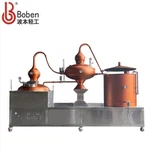
This distillation system is named after the province in southwestern France, where Cognac is produced. This batch distillation system composed of pot stills, direct fire heating, and two-way distillation is called (Charente Pot Still la distillation charentaise), which is a very representative classic process. Calvados in the Auge region of Normandy, France, and a few Armagnac brandy producers also use this system to make wine. The characteristics of this distillation system are relatively small volume and direct fire distillation, which helps to accurately obtain the heart of the wine with good flavor. There is a slender and curved swan neck at the top of the distiller. When the steam rises here, it is easily condensed by the outside air and naturally flows back into the distiller, increasing the contact with copper and achieving the effect of flavor purification. Through vitality control, it is enough to obtain the first distillate with pure flavor, and even the head of the wine can be collected at low temperature to remove the fat taste.
In short, although the Charente pot still is not completely effective in purifying flavors, the standard process is two-pass distillation, and the swan neck design connected at the top can promote condensation and natural selection of wine. As long as the appropriate operating settings are found, the newly made spirits are naturally beautiful. For this reason, as long as the distilled liquor juice is clean enough, the resulting young spirits will be quite delicious.

2. Armagnac column still, partial continuous distillation
Armagnac brandy is made using a column still equipped with a layer plate, called an Armagnac continuous still (Alambic continu armagnacais). Because the process is a single-pass distillation, it is sometimes called Armagnac single-pass distillation, but it is also often described as an incomplete continuous distillation. Although a few producers also use pot stills to make wine, the use of a unique Armagnac still is one of the important sources of the flavor and personality of Armagnac brandy.
The cold wine to be distilled enters the distillation system from the bottom of the cooling tank, acting as a medium to cool the spirits: the still cold wine to be distilled is then introduced upward into the condensation tank above the cooling tank, and through heat exchange, the gaseous spirits are cooled and condensed into liquid. The wine to be distilled gradually heats up until it reaches the top of the condensation tank, where it enters the top of the distiller and truly enters the distillation process. At the same time, the cold wine to be distilled continues to enter the distillation system from the bottom of the cooling tank, forming a continuous system with uninterrupted feeding. The distiller consists of two parts. The lower part is the distillation pot, and the upper part is the distillation column, which is composed of layers. Between the layers, there are channels that allow liquid to flow downward, and there are gaps that allow steam to rise upward. By controlling the firepower, a certain balance is achieved between the two. After the upward steam reaches the top, it will enter the condenser tank, and then enter the cooling tank to obtain a new spirit with an alcohol concentration of about 52-60%.
The spirit condensed from this system always contains some heads, which cannot be removed. The complete continuous distillation system consists of two distillation columns. The most volatile substances will be condensed at the top of the second distillation column. After the condensate is extracted, it can be discarded. However, the new spirit of the Armagnac distiller has these ingredients. This is the biggest difference between Armagnac continuous distillation and general continuous distillation, and it is therefore called incomplete, or partial continuous distillation.
3. Steam indirect heating batch single-pass distillation
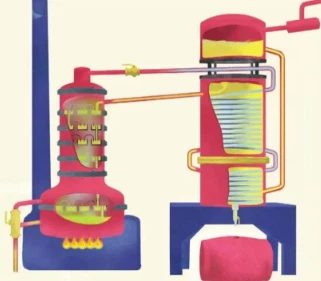
This type of batch still with excellent performance, multiple functions and flexibility is the most common distiller equipment in the brandy industry. The heat source input method can be direct fire heating or steam jacket heating. The round shape is convenient for heat conduction. If a stirring arm is installed, it can not only save a lot of energy, but also be used to distill pomace and fruit crushing. During the distillation process, starting the stirring can prevent the bottom of the pot from coking. The top of the still can choose something like a boiling ball or a purifier, and the distillation column can usually be designed directly on the top of the pot still. The roof of some wineries' distillation rooms is high, so they deliberately develop upward to create a visual shock. The distillation column can also be installed next to the pot still, and a handle can be installed on the outside of each layer to control the valve of the internal layer. Through experiments and fine-tuning, the detailed configuration of the distillation column, combined with the operation design including fire input, can produce spirits with optimized quality and meet expectations.
4. Domfront Calvados Column Still, Single-channel Still
The Calvados from Domfront, Normandy, France, uses a high proportion of pears and apples, and ferments the juice after pressing. The column still (alambic a colonne) is used to distill the fruit wine to obtain strong liquor. Although the appearance is a column structure, the internal structure and operation method are different from the continuous distillation of the Armagnac column still, and also different from the continuous distillation of the general column still. This process is not considered as continuous distillation in the local area, but is called single-channel distillation. The Domfront column single-channel still system consists of three parts: one is the distillation pot, the second is the primary distillation column, and the third is the secondary distillation and condensation column. The fruit wine to be distilled is injected from the top of the primary distillation column. After entering the distillation system, it passes through 15 to 16 layers from top to bottom. The steam pot boils water to supply a steady stream of steam, which is injected into the bottom of the primary distillation column. The steam meets the fruit wine, extracts the alcohol and flavor substances, and enters the bottom of the secondary distillation and condensation column in gaseous state. The upper part of the re-distillation and condensation column is a condenser that uses the fruit wine to be distilled as a cooling medium, while the lower part is a re-distillation column with a re-distillation function, equipped with 8 layers. Alcohol vapor gradually condenses and purifies from top to bottom, and is finally introduced into the upper part in a gaseous state to enter the condensation process to obtain strong liquor.