


Optimization process of beer yeast fermentation and yeast extract

84cap beer yeast and its extract technology
Among the industrial applications of Saccharomyces cerevisiae, the two most well-known places are that it assists in brewing beer, converting sugar into alcohol while also adding flavor; the other is that active yeast is used in baking bread, helping baked goods to be fluffy, and also Can add flavor. Although, strictly speaking, both are Saccharomyces cerevisiae, there are still many differences in the design of the industrial fermentation process.
This article mainly discusses the engineering process of yeast fermentation in the beer brewing process, as well as the latest technological direction of beer waste yeast treatment, to provide some information for enterprises.
1. Typical processes of beer brewing
The following figure is a typical process flow chart for beer brewing:
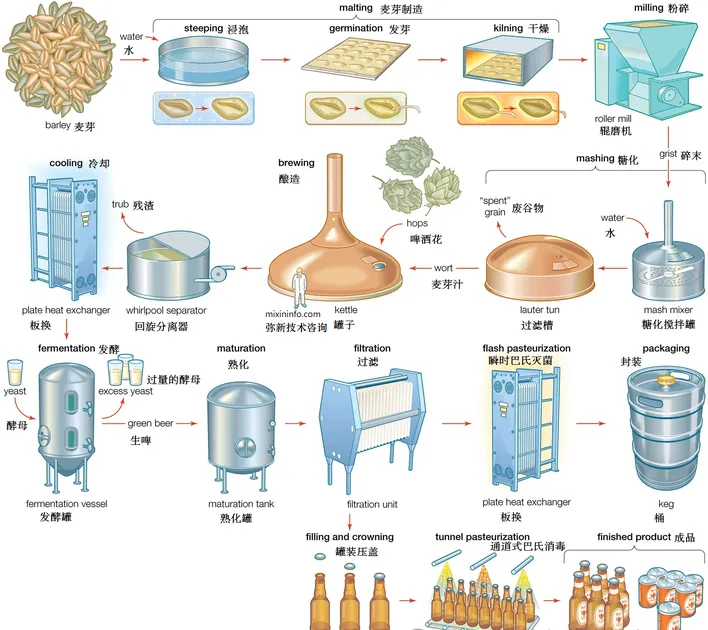
The beer brewing process includes malt production, grinding, mashing, extract separation, hop addition and boiling, hop and sediment removal, cooling and aeration, fermentation, yeast separation from the beer, aging, maturation and packaging, among others. The purpose of the entire process is to convert grain starch into sugar, then ferment it with yeast to produce alcohol, and finally obtain the finished product.
There are many types and flavors of beer that are beyond the scope of this discussion. Here, we only briefly describe and understand it.
2. Fermentation process engineering of beer yeast
The fermentation of beer yeast is actually a batch fermentation. The tanks used are mainly for converting sugar into alcohol, which is different from the ultimate purpose of baker's yeast fermentation, which is to obtain the yeast itself. Common beer fermentation tanks are all cylindrical and conical fermentation tanks, as shown below:

The design of the beer fermentation tank is of course because it is an anaerobic fermentation, which is quite different from our conventional aerobic fermentation tanks. However, the design is mainly based on the following considerations:
a:The cone bottom helps the residue and yeast settle at the end of fermentation;
b:The cone bottom facilitates the outflow of clear liquid and the stratification of residue;
c:The cone bottom also aids in CIP cleaning, etc.
Some types of continuous fermentation methods have also been tried for beer yeast fermentation, such as the multi-tank stirring continuous fermentation system shown below:

For example, the following continuous tower fermentation tank system, and of course other more classic large-scale anaerobic fermentation tanks, are used in the newer field of syngas anaerobic fermentation, which are not listed here:

These continuous fermentation systems still have a lot to learn from. For example, the current continuous anaerobic fermentation system, how to circulate, how to recycle, how to improve the yield, etc., can be learned and studied in a deeper level. However, as far as this continuous fermentation system is used for beer yeast fermentation, they fail. The reason is probably that the yield, flavor, etc. are not well controlled. Many people in China have also used this kind of continuous fermentation for other products, but they have not gotten the essence and basically ended in failure. Therefore, here is also a reminder for passing fermentation masters.
The technology and specific operations of the beer fermentation process will not be discussed here. If necessary, we will discuss it separately.
Treatment of waste beer yeast
3.1. Conventional treatment methods of waste beer yeast
Spent Brewer's Yeast is the second most abundant by-product of breweries. The main reason is that the amount of yeast produced during beer fermentation is approximately 4 to 5 times the amount of yeast added at the beginning of fermentation. This means that for every kilogram of yeast used to start fermentation, an additional 4 to 5 kilograms of yeast are produced. Although these yeasts can be recycled, the number of times is limited, so they are called waste yeasts.

Relatively speaking, the relatively simple method for processing beer yeast is to first carry out pre-treatment such as washing and debittering, then carry out wall crushing, and then further process to obtain the required yeast powder or yeast extract. For specific yeast extract processing technology, please refer to our other article on yeast extract technology. Here is a brief description of the process from beer yeast to yeast extract. The process includes:
Yeast fermentation - yeast decomposition - centrifugation - evaporation and concentration - drying

The final product obtained by this simple beer yeast treatment process is mainly used in the field of animal feed, but cannot be used in the fields of food and cosmetics. It can even be used as a medium addition in the field of biological fermentation, which is unsatisfactory. This is very different from yeast extract produced purely from baker's yeast using sugar sources. Of course, on the surface, it is a price difference, but in fact, we should expand our thinking, find out some reasons for the differences, and increase the market value of beer yeast.
3.2. Reasons for the inferior quality of beer yeast extract
The extract of beer waste yeast has a strong bitter taste. According to the bitterness level of beer between 5 and 120, the bitterness value EBU of many dry extract powders tested is greater than 8, many are even greater than 30, and even accompanied by some undesirable coke. Pasty taste. The quality of beer yeast extract is slightly inferior, and the reasons are probably as follows.

a:Beer waste yeast, these are mainly bitter substances produced in hops, namely iso-alpha acids (such as humulone and isohumulone), tannins, etc., which will be adsorbed to the yeast cell wall during the fermentation process; ·
b:The fresh yeast coming out of the brewery has different survival rates depending on its location and circulation rate, ranging from 30% to 90%, and the quality varies;
c:In the collection process of waste yeast in breweries, different process facilities will damage the yeast itself to varying degrees and cause varying degrees of pollution; ·
d:There are many methods to disrupt the yeast cell wall as shown in the figure below, including enzymatic methods, ultrasound, chemical methods, etc., each of which will have a different impact on the final result.
3.3. Suggestions on improving the quality of beer yeast extract
The output of spent beer yeast is large, and there is a lot of room for value improvement. In order to improve the quality of waste yeast products, many companies have made a lot of efforts in these areas, especially some well-known international beer brewers. For example, Anheuser-Busch InBev has launched a life yeast project to specifically overcome this problem; such as The French yeasty start-up company has implemented a unique technical innovation to eliminate bitterness; Japan's Kirin Beer, for example, has already had some patented technologies for removing bitterness from beer yeast.
The above all prove that the use of waste beer yeast to make high-end yeast extract products has been realized internationally. We referred to some classic foreign beer brewing books, as well as the fermentation and production technology of yeast extract, and of course the recent international research results on the process of waste beer yeast extract. Referring to these is nothing more than seeking the reasons and breakthrough techniques. Through simple organization, the following are our general suggestions for improving the quality of yeast extract, for reference only.
It is more beneficial to use fresh spent yeast than dried spent yeast; ·

Although the results are reflected in the yeast products, relatively speaking, the pretreatment process of waste yeast is more important;
The idea of making all products into high-end extracts may not be realistic, and we need to consider diversion from the source of beer yeast;
The subsequent cell wall disruption process may have many changing factors, leading to different results, but it is also the direction of most research. Understanding more foreign information will help to choose the most appropriate industrial production method;
Please refer to the above precautions for the production process and operation of baker's yeast to help stabilize the quality of beer yeast extract.
Although, from our perspective, we believe that this may improve the design and product quality of beer waste yeast extract products, before implementation, we also recommend that some companies and research institutions can do the same as industrial production. It is best to explore small and pilot tests before proceeding to industrial production.


