Pot Stills vs. Column Stills
The application of distillation technology in the production of spirits is crucial and is an important means of purifying alcohol. The purpose of distillation is to separate alcohol from liquor, the main component of which is water. The principle of increasing the alcohol content of liquor is that the boiling point of ethanol (edible alcohol) (78.3°C) is lower than the boiling point of water (100°C). After the alcohol solution is heated, it will be concentrated into liquor with a higher alcohol content through boiling, collection and cooling. A large amount of water, solids, pigments, sugars and most acids contained in the fermented liquor are basically left in the residual liquid. There are two widely used distillation methods, column distillation and pot distillation.

1. Pot Stills
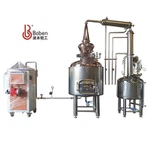
Pot stills are the oldest and simplest distillation equipment. The pot still is a pot-shaped container, usually made of copper, that holds the base liquor. When the liquor is heated, the alcohol evaporates into steam, which rises to the neck of the still, which extends from the top of the pot like a chimney. The steam enters the condenser from the neck and is cooled by cold water to become a solution. This new liquor has a higher alcohol content than the original liquor. However, pot stills can only increase the alcohol content of the liquor by a small amount, so multiple consecutive distillations are required to obtain a sufficiently concentrated liquor from the alcohol solution.
During the second distillation process, the still only contains part of the liquor collected from the condenser. The most volatile components boil first and become the heads of the distillation. Next is the heart of the distillation (or liquor), which has a very low impurity content. This part of the liquid can be used to make liquor. The least volatile components boil last and are called the tails of the distillation. The head and tail of distillation are not used for the final liquor because they contain high concentrations of harmful ingredients.
Distillation using a pot still is a very complicated process that requires batch distillation and has a relatively low distillation efficiency. To obtain a very pure, high-concentration distilled liquor, two or even more distillation steps are required. However, in any case, the purity of the distilled liquor obtained by distillation using a pot still is often difficult to guarantee.
2. Column distillation
Column stills are very tall vertical cylindrical containers. The interior of all column stills is divided into several layers, each of which is called a "plate". There are many holes on these plates, and the liquor and steam can flow freely up and down in the still. After the liquor is heated, it becomes steam and enters the still.
Once the still is started, the alcohol vapor will flow up along the still. The vapor is liquefied at each layer, forming a liquid layer in each plate. The rising vapor is forced to pass through this layer of liquid to produce boiling, which in turn forces the vapor to pass through the upper plate and flow up. Each layer is undergoing this mini distillation, and then the distillation continues layer by layer. With each layer of distillation, the alcohol concentration is increasing. Therefore, if there are enough layers, the column still can distill nearly pure ethanol. The column still can be operated continuously and is very efficient, which means that new liquor can be produced continuously.
3. The impact of different distillation processes on the style of spirits
At various stages of spirit brewing, the choice of distiller will affect the final taste and style of a spirit, and will affect the category to which this wine belongs. Generally speaking, spirits brewed with pot stills have a lower alcohol content, contain impurities, and have a very rough taste. They need to be aged in oak barrels or filtered with charcoal to make the wine soft, but they have more aroma. Spirits brewed with column stills have a higher alcohol content, and their aroma and characteristics are not obvious. However, when the alcohol content is reduced to the standard bottling concentration of about 40% (usually diluted with water), the taste of the wine is relatively smooth, so it can be bottled directly and consumed without further aging.
Spirits made with pot stills include Cognac, Malt Whiskey, London Dry Gin and Tequila. Spirits made with column stills include grain whiskey. Spirits that can be distilled both in pot stills and columns include Armagnac (mostly using column stills), Irish Whiskey, Bourbon Whiskey, Rum and Tequila.