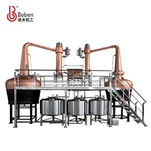
The shape of a whisky still plays a crucial role in determining the spirit's final flavor profile. Beyond the size of the still, its design-particularly the shape of the pot and swan neck-influences the interaction between alcohol vapors and copper, affecting the spirit's character. Scotch whisky distilleries use various still shapes, each contributing to distinct flavor profiles. Here are the most common types:
1. Onion Shape (Straight-Neck Still)
The onion-shaped still, named for its bulbous, rounded body, features a smooth transition between the pot and the swan neck without any constriction. This design maximizes the contact area between alcohol vapors and copper. However, due to the lack of narrowing in the neck, the vapors spend less time interacting with the copper, resulting in a robust, full-bodied whisky with rich and intense flavors.
Example: The Macallan uses onion-shaped stills, contributing to its signature rich and complex spirit.

Onion-shaped still (Image source: Internet)

The Macallan's still room (Image source: Internet)
2. Bulb Shape (Ball-and-Tube Still)
The bulb-shaped still has a distinctive spherical condenser at the junction between the pot and the swan neck. This bulb allows heavier alcohol vapors to condense and reflux, effectively redistilling them. This process refines the spirit, producing a lighter, cleaner, and more delicate whisky.

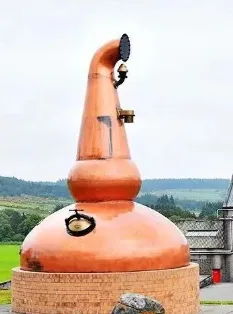

Bulb-shaped still (Image source: Internet)
3. Lantern Shape (Tapered-Neck Still)
The lantern-shaped still features a noticeable narrowing between the pot and the swan neck, resembling a traditional lantern. This constriction reduces the volume of rising vapors, decreasing copper contact in the neck. As a result, the vapors cool more efficiently, increasing reflux and yielding a lighter, more floral, and fruity spirit.


Lantern-shaped still (Image source: Internet)
4. Lomond Still
The Lomond still is a hybrid between a pot still and a column still, incorporating perforated plates within the neck. Its key advantage is the ability to produce spirits of varying strengths and flavor profiles from a single still. However, Lomond stills are difficult to clean due to residue buildup on the plates, and their efficiency is limited. As a result, few distilleries use them today.
Examples: Scapa and Dalmore are among the rare distilleries that still employ Lomond stills.


Conclusion
The shape of a whisky still significantly influences the spirit's character-whether it's bold and rich (onion), light and clean (bulb), floral and delicate (lantern), or versatile (Lomond). Distilleries carefully select their still designs to craft whiskies with their desired flavor profiles, making the still an essential element in whisky production.