Whiskey Production Process

Process Flow:
Raw Material Malt Crushing → Mashing → Fermentation → Distillation
I. Malt Crushing:
Malt is crushed using a roller mill. The malt first needs to be ground, and the coarse powder after grinding is called "grist." If the grinding is too coarse, the sugar cannot be fully extracted; if it is too fine, the malt will clump together, and the sugar still cannot be fully extracted.
II. Mashing and Filtration:
The crushed malt is poured into a mash tun, and hot water is added to extract the soluble sugars. The mixture of malt and water is called the "mash." The mash is stirred in the mashing tun for several hours. During this process, the sugars in the malt dissolve and are drained through the bottom of the mash tun. The resulting liquid is called "wort."
The material-to-water ratio is set at 1:3/4. The water is heated to 70°C, and the crushed malt is added while stirring. Once the temperature drops to 64-65°C, stirring is stopped, and the temperature is maintained for 40-50 minutes. The circulation pump is then started until the wort becomes clear, after which filtration begins. (The filtered wort can be pumped into a weak wort tank for temporary storage.) After the first wort filtration is completed, the first sparging is conducted using water at 80°C. The second wort is collected through sparging and filtration. Once the required volume of wort, including the first wort and the first sparging wort, is collected, it is passed through a plate heat exchanger to cool to 20°C before entering the fermentation tank.
Fermentation: After the wort from the weak wort tank is pumped into the fermentation tank via the plate heat exchanger, a second sparging can be performed using water at 95°C. The wort from the second sparging is pumped into the weak wort tank for temporary storage and used as water for the next mashing process.

III. Fermentation:
The wort, cooled to 20°C through the plate heat exchanger, enters the fermentation stage. Depending on the yeast selected, the optimal active temperature range for fermentation is controlled. The fermentation time is 70-90 hours (3-5 days). The fermentation tanks are not sealed during the entire process, and the valves of the CIP pipes are kept open. (Note: The volume and quantity of fermentation tanks should match. Typically, the volume of the fermentation tank is designed to be 1:1 or 1:2 relative to the mash tun. The number of fermentation tanks is calculated based on the fermentation cycle. For example, if the fermentation cycle is 3 days, at least 3 fermentation tanks should be configured to meet the cycle requirements.
IV. Fermentation Tank Sterilization:
Hot water at 90-95°C is introduced into the fermentation tank through the CIP pipe, with simultaneous inflow and outflow, until the temperature gauge shows 70-80°C. The water inflow for sterilization is then stopped, and the tank is left unsealed for future use (with the bottom valve open).
V. Distillation:
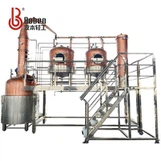
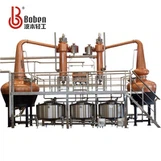
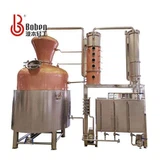
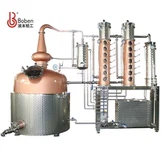
The fermented liquid is pumped into the crude distillation pot of the still (typically transported using food-grade hoses, which are installed before pumping and removed and cleaned after use). The crude distillation pot is heated to begin distillation, and the low-alcohol liquor collected after crude distillation is pumped into the rectification pot for refinement. During refinement, the distilled liquor is separated into the "head," "heart," and "tail." The head and tail can be collected in a single container and used as raw material for the next batch of refinement. The heart is the desired liquor, which will later be stored in oak barrels.
If it is what you want, contact me via jenny@bobendistillers.com
Contact me via jenny@bobendistillers.com or WhatsApp +86 18072880323 for detailed technical specifications and custom solutions!