What is a column still
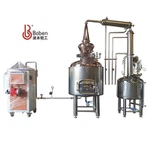
Column stills, also known as continuous stills, are an innovative technology in the distillation process. They are widely used in the production of spirits such as whiskey, rum, and vodka. The column still design is unlike traditional pot stills, column stills consist of multiple plates or fillers, which enables the distillation process to be carried out continuously.
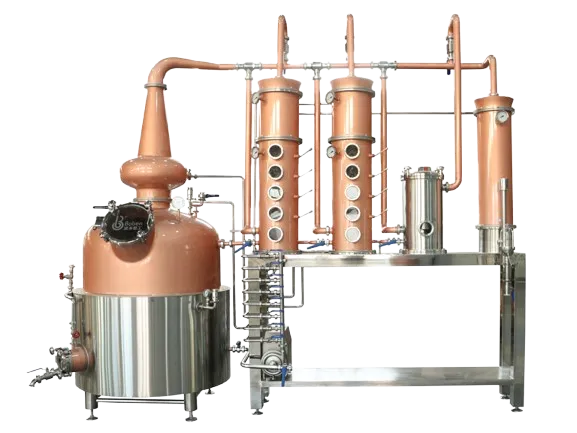
Column stills usually consist of a heating system, a distillation tower, a condenser, and a collection system. The heating system provides heat energy at the bottom of the tower to evaporate the liquid, and the alcohol vapor rises in the distillation tower and passes through multiple plates or fillers for separation and purification. The reflux system enhances the distillation efficiency and improves the purity of the alcohol. Finally, the vapor is cooled into liquid in the condenser, and the distillation products of different purities are separated through the collection system. These parts work together to enable the column still to efficiently and continuously produce high-purity alcohol and other distilled products.
History of column stills
1. Origin
The origin of the column still can be traced back to the ancient civilization period, but the early form was relatively simple. Its basic principle is to separate different substances based on the difference in boiling points. Ancient alchemists and pharmacists may have begun to use this basic distillation idea when trying to separate mixtures (such as extracting stronger components from wine).
However, the prototype of the equipment that is really similar to the modern column still appeared around the late 18th century to the early 19th century.
2. Early development
Inventors and early application areas
Although it is difficult to determine who invented the column still, during the Industrial Revolution, with the booming development of the chemical industry and the brewing industry, the column still began to be widely used. In the brewing industry, it was originally used for the production of spirits such as brandy and whiskey. At that time, brewers found that column stills could produce spirits with higher alcohol content more efficiently.
For example, in the Cognac region of France, column stills were used for the initial distillation of brandy, which could continuously process a large amount of wine raw materials, allowing the scale of brandy production to be expanded.
Early structural features
The structure of the early column distiller was relatively simple. It mainly consists of a vertical distillation column and a heating device. The distillation column is usually equipped with some fillers, such as broken porcelain pieces or glass beads, which increase the contact area between the steam and the liquid and help improve the distillation efficiency.
The heating device is generally at the bottom of the distillation column, and the raw material liquid is vaporized by direct or indirect heating. The generated steam contacts the filler and the column wall during the rising process, gradually realizing the separation of components with different boiling points.
3. Important changes
Industrial transformation period
From the mid-19th century to the early 20th century, with the acceleration of the industrialization process, the column distiller ushered in a major change. In the chemical industry, the demand for large-scale distillation of raw materials such as petroleum prompted the column distiller to develop in the direction of large-scale and high efficiency.
Engineers began to optimize the internal structure of the distillation column. For example, new plate structures such as bubble cap plates and sieve plates were invented. There are many bubbles on the bubble cap plate, and the steam enters the liquid layer through the small holes of the bubble cap to form bubbles. This structure makes the gas-liquid contact more complete and the separation effect better. The sieve plate has many small holes on the plate, and the steam can directly contact the liquid through the small holes. This structure is relatively simple, but it can also effectively improve the distillation efficiency.
At the same time, in order to adapt to different production scales and raw material characteristics, the material of the column distiller has more choices. In addition to traditional copper and cast iron, corrosion-resistant materials such as stainless steel have begun to be widely used, which enables the column distiller to be used to process more corrosive chemical raw materials.
Introduction of automated control
After the mid-20th century, with the development of electronic technology and automation technology, column distiller began to introduce automated control systems. Temperature sensors, pressure sensors, flow controllers and other equipment were installed on the distiller, allowing operators to accurately control various parameters in the distillation process.
For example, through the automated control system, the heating power can be automatically adjusted according to the feed rate of the raw materials to keep the temperature and pressure in the distillation column stable, thereby improving the stability of product quality. At the same time, automated control can also achieve remote monitoring and operation, greatly improving production efficiency and safety.
4. Modern column distiller
High-tech integration and refined operation
The modern column distiller is an integrated body of high technology. It is equipped with an advanced computer control system that can simulate and optimize the distillation process in real time. Through complex algorithms, the distillation parameters can be automatically adjusted according to factors such as raw material composition and product requirements to achieve refined operation.
For example, in the field of fine chemicals, when producing high-purity organic compounds, modern column distiller can accurately separate components with very small boiling point differences, and the purity can reach more than 99.9%.
Integration of environmental protection and energy-saving concepts
With the enhancement of environmental protection and energy-saving awareness, modern column distiller also fully considers these factors in the design and operation process. By optimizing the heat exchange system and recycling the waste heat in the distillation process, energy consumption is reduced.
At the same time, there have been great improvements in the sealing and exhaust gas treatment of the equipment. The use of efficient sealing materials and exhaust gas purification devices reduces the emission of pollutants such as volatile organic compounds (VOCs), meeting increasingly stringent environmental protection requirements.
Multi-functional and customized design
The modern column distiller also has the characteristics of multi-functionality and customization. It can be customized according to different industry needs, such as for producing high-purity edible alcohol in the food and beverage industry, for extracting active ingredients in drugs in the pharmaceutical industry, and for extracting spices in the perfume industry.
Moreover, some column distiller can also switch between multiple distillation modes, such as intermittent distillation and continuous distillation modes, to meet the requirements of different production scales and product types.
How Does A Column Still Work
1. Feeding stage
First, the raw materials to be distilled (such as fermented wine, chemical raw material mixture, etc.) are transported to the column distiller through the feed pipeline. The raw materials are introduced into a certain position of the distillation column, which is usually in the middle or upper part of the distillation column, depending on the nature of the raw materials and the desired distillation effect.
For example, when producing high-purity alcohol, the fermented wine is preheated and enters from the middle of the distillation column. This is because the preheated wine can reach the boiling point faster, and entering from the middle can better utilize the temperature gradient and gas-liquid equilibrium state that has been formed in the distillation column.
2. Heating and vaporization stage
There is a heating device at the bottom of the column distiller, such as a steam heating coil or an electric heater. When the heating is turned on, the heat is transferred to the raw materials in the distillation column by conduction and convection. The raw materials begin to boil under the action of heating, and the liquid is converted into steam.
Take petroleum distillation as an example. After crude oil is heated to a certain temperature, the various components gradually vaporize in the order of boiling point from low to high. Light components (such as gasoline components) vaporize first, forming steam that moves upward. The control of heating temperature is very critical. Different raw materials and target products require different temperature ranges to achieve effective vaporization.
3. Gas-liquid contact and separation stage (in the distillation column)
There are various structures inside the distillation column to promote gas-liquid contact and separation. The most common are plate structures (such as bubble cap plates, sieve plate plates, etc.) or packing structures.
How the plate structure works:
There are many bubbles on the bubble cap plate, and the steam enters the liquid layer from the small holes of the bubble cap to form bubbles. These bubbles rise in the liquid and fully contact the liquid. In this process, the high-boiling point components in the steam will partially condense into the liquid, while the low-boiling point components in the liquid will vaporize into the steam.
The sieve plate plate has many small holes on the plate, and the steam directly contacts the liquid through the small holes. The liquid forms a certain liquid level on the plate, and the steam passes through the liquid layer, which also realizes the heat and material exchange between the gas and the liquid.
How the packing structure works:
The packing is some irregularly shaped solid materials (such as ceramic Raschig rings, metal ball rings, etc.), which are filled in the distillation column. The steam rises in the gaps of the packing and contacts the liquid film attached to the surface of the packing. This contact mode increases the gas-liquid contact area, making the mass transfer process between the steam and the liquid more complete. Low-boiling point substances continue to vaporize into the steam, while high-boiling point substances remain in the liquid and flow downward with the liquid.
4. Condensation stage of rising steam
After the gas-liquid separation in the distillation column, the steam containing low-boiling point components continues to move upward and reaches the top of the distillation column. There is a condenser at the top, which is usually used to cool the steam by circulating water or other cooling media.
When the steam encounters the cold surface of the condenser, condensation occurs and changes from gas to liquid. For example, in the distillation of spirits, alcohol vapor is cooled into liquid alcohol in the condenser, and the liquid alcohol is collected in a specific container.
5. Product collection and residual liquid discharge stage
The collected condensate is the product after distillation. According to different boiling point ranges and distillation purposes, condensate at different stages can be collected. For example, when fractionating petroleum, different fractions such as gasoline, kerosene, and diesel can be collected.
At the same time, at the bottom of the distillation column, the unvaporized high-boiling components and impurities are discharged as residual liquid, which may be further processed (such as in the chemical industry) or treated as waste (such as in some simple winemaking processes).
Column Still VS Pot Still
There are two main types of distiller: column still and pot still.
1. Distillation method: pot still uses batch distillation, also known as intermittent distillation. It can only distill one batch of raw materials at a time, and it needs to wait for one batch to be completed before starting the next batch; column still can perform continuous distillation, without waiting for one batch to be completed before starting the next batch, and can distill 24 hours a day without interruption.
2. Taste style: pot stills are usually used in the production of malt whiskey, and can retain more flavor substances, including peat flavor, so the resulting liquor has a heavier texture and richer flavor; column stills get purer liquor, higher alcohol content, lighter style, but relatively less flavor substances.
3. Common applications: pot stills are often used in the production of cognac, malt whiskey, London dry gold and tequila, etc.; column stills are mainly used in the production of grain whiskey
Conclusion
As you can see, the uniqueness of the column still lies in its ability to continuously distill and efficiently purify, making it an indispensable device for modern spirits production. Whether it is producing highly pure vodka or retaining some flavor components of rum and whiskey, the column still plays a vital role.
If you are looking for high-quality distillation equipment, or want to learn more about the distillation process, Boben can provide you with professional solutions. We focus on the research and development and production of high-efficiency distillation equipment. Welcome to contact us for more information about distillation technology!