The Distillation Process Of Brandy
Pot distillation method:
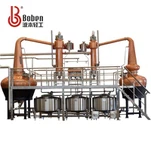
The structure of a kettle still:
The Charente kettle still is made of copper, and the advantages of using copper materials are:
One is that copper has good resistance to acid in wine, that is, it is resistant to acid corrosion; Secondly, copper has good thermal conductivity, which reduces heat energy consumption; Thirdly, during the heating and distillation process, copper can form insoluble copper salts with butyric acid, caproic acid, octanoic acid, sunflower acid, lauric acid, etc., thereby removing these acids with adverse flavors and improving the quality of brandy.
The copper effect of brandy distillation.

Distillation process and operating techniques:
1.Simple Distillation:
Dismantle the small reflux device and add water to the gooseneck kettle → preheat the small stove for 36 hours → add tartaric acid to continue preheating for 24 hours → pretend to be a small reflux device and gooseneck → connect the piston pump to reverse cycle brush the pipeline → clean the pressure inside the kettle with tartaric acid → low temperature liquor output → adjust the gas pressure multiple times for 11 to 12 hours for crude distillation, collect about 600L of liquor heart → enter the 1-hour liquor flavor collection.
After three rounds of crude distillation, approximately two tons of crude distillate can be obtained, followed by one distillation.
2. Distillation:
The crude distillate enters the kettle → heats for 2 hours → removes the liquor head → adjusts the temperature to collect the liquor center → adjusts the temperature to rectify → adjusts the temperature to rectify [the liquor center alcohol content cut-off is 68-70% (volume fraction)] → collects the secondary crude distillate for about 4 hours → collects the liquor tail.