Currently, large-scale modern agricultural farms overseas have widely adopted an innovative production model featuring "Dual Production Lines in One Park with Full Raw Material Utilization". Relying on self-grown fruits, vegetables and grains as raw materials, such farms operate two integrated production lines for premium bottled fruit wine brewing and craft spirit distillation. Secondary by-products including defective fruits, fruit pomace and post-fermentation stillage undergo secondary deep processing, enabling zero agricultural waste, low-carbon manufacturing and high-end finished products. Fully compliant with food safety, alcohol taxation and emission environmental regulations of the EU, North America and Australia, this model has become a benchmark for deep processing of agricultural produce and circular agriculture development.

Graded Quality Improvement & Closed-Loop Utilization: Standardized Deployment of Fruit Wine Brewing Line
The core strengths of the project's fruit wine production line lie in graded raw material utilization and zero waste across the entire workflow, fully aligned with overseas export criteria. Automated machinery performs intelligent sorting of fresh fruits: premium fruits are fermented into high-end bottled fruit wine, while defective fruits, pomace and peels are collected uniformly as feedstock for spirit distillation. Low-temperature operations throughout the process prevent raw material oxidation and deterioration. Category-specific temperature-controlled sealed fermentation is deployed with full-process nitrogen blanketing technology to suppress miscellaneous bacterial contamination and preserve natural fruit aroma. A dual-model pressing configuration is adopted: fine pressing extracts pure juice for premium fruit wine, while continuous pressing processes bulk secondary materials to produce distillation mash. To meet mandatory export standards for Europe and America, a low-temperature cold stabilization stage is added to completely eliminate cloudiness of finished wine under cold conditions. The entire line delivers an eco-friendly closed-loop production cycle: settled production wastewater is recycled for orchard irrigation, and solid fruit pomace is further processed on demand or converted into organic fertilizer for farmland application. All equipment is constructed from FDA and EU-certified 316L food-grade stainless steel, paired with PLC intelligent temperature control, aseptic filling and oak aging facilities, balancing large-volume mass production with bespoke premium quality.
Dual Distillation Processes & Precise Quality Control: Develop a Premium Spirit Portfolio

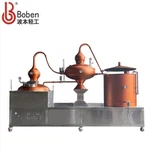
Drawing on secondary by-products from fruit wine production and self-owned grain supplies, the project establishes multi-product spirit lines for brandy, whisky and gin. It integrates two distillation systems: craft pot still distillation for high-end bespoke spirits and column still distillation for mass-produced base spirits, covering both luxury custom and mainstream base spirit markets and unlocking high-value conversion of secondary raw materials. Production adheres to stringent international liquor safety standards. Precise fractional cutting separates and discards harmful foreshots and feints rich in methanol and fusel oils, retaining only pure heart cuts as the finished base spirit. Copper distillation hardware effectively absorbs off-notes, elevates fruit aroma and refines mouthfeel, forming a core competitive advantage in product quality. A full-process compliance and traceability system is implemented for overseas market access. Spirits undergo oak barrel maturation under constant temperature and humidity per international standards, with complete records maintained for production, aging and volume loss data. Online intelligent monitoring equipment tracks alcohol content and output in real time, generating fully retrievable data to satisfy overseas tax, customs and industrial regulatory requirements. Equipment is precisely matched to product positioning: high-purity copper pot stills craft limited-edition premium spirits, extracting distinctive herbal notes unique to the farm; stainless steel rectification columns enable efficient high-volume production of base spirits. The entire distillation workshop is equipped with Class A explosion-proof machinery suited for high-risk alcohol manufacturing environments to guarantee operational safety.

Intensive Supporting Facilities & Low-Carbon Compliance: Build an Integrated Production Support System
The project features integrated, compact configuration of shared utilities: a unified system serves both the fruit wine and distillation lines, substantially cutting capital investment costs. A centralized refrigeration system meets temperature control demands for all production stages, while an integrated CIP (Clean-in-Place) system complies with international food hygiene audit standards to standardize and sanitize manufacturing operations efficiently. Supporting water circulation and wastewater treatment systems enable water recycling, with treated effluent meeting discharge thresholds before being reused for farm irrigation. Biomass boilers burn fruit pomace and wood chips as fuel, delivering low-carbon energy efficiency and eligibility for special overseas agricultural subsidies. The PLC central control system unifies full-process data collection and traceability, fully fulfilling tax, environmental and customs compliance obligations.
Four Core Guiding Principles Underpin a Benchmark Model for Modern Agricultural Deep Processing
Sustainable long-term compliant operation of the project is anchored by four core principles:
- Material Compliance: Food-grade stainless steel and high-purity copper are used in respective process sections, supported by complete certification documentation.
- Output Adaptability: Production capacity is flexibly adjusted across peak and off-peak harvest seasons to maximize annual equipment utilization, accounting for the seasonal nature of fruit and vegetable harvesting cycles.
- Safety Compliance: Zoned explosion-proof workshop design balances rigorous production safety and cost-effective equipment investment.
- Environmental Protection: A comprehensive resource recovery system for solid waste, wastewater and biogas delivers fully zero-waste circular manufacturing, qualifying the facility for overseas tax incentives and special low-carbon agricultural support policies.
Industry analyses indicate that the farm's dual-output "fruit wine + spirit" model connects the full industrial chain from crop cultivation to premium deep processing. It significantly boosts product added value and overseas export competitiveness, delivering dual ecological and economic benefits via circular manufacturing. The project offers a replicable benchmark model for standardized, low-carbon and industrialized development of large-scale modern agriculture.