As distillation equipment manufacturers, we receive nearly identical inquiries every day. Typically, the client's opening question is: "What is the maximum capacity of your pot still?" When this happens, we seldom rush to provide quotations. Instead, we first clarify their project plan: will they produce single malt whisky or grain whisky?


These two product lines require entirely different equipment packages. Simply comparing the capacity of copper stills can create hidden risks at the early project stage.
Raw material and process set the first dividing line. Single malt whisky uses malted barley as raw material, with a relatively fixed front-end setup revolving around malt milling, mashing, wort separation and fermentation. Grain whisky relies heavily on unmalted grains such as corn, wheat and rye. Their starch must undergo gelatinization and liquefaction prior to mashing, which requires additional dedicated front-end equipment. On numerous occasions, clients have attempted to apply a single malt equipment list directly to grain whisky projects, only to end up redesigning the whole process starting from raw material handling.


Differences in fermentation vessels lie not in appearance, but in capacity matching logic. Single malt production operates in batches. The number of fermenters is determined by balancing each mashing volume, fermentation cycle and daily distillation runs. Wash fermented for 3–5 days may sit in fermenters awaiting distillation simultaneously. Grain whisky pairs with continuous column stills, so its fermentation system must feed the distillation tower steadily and continuously. Any interruption in feedstock will shut down the entire production line.
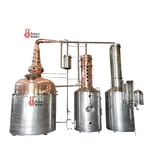
The distillation stage sees the most critical distinctions. Single malt whisky is generally produced using copper pot stills, with a combination of wash still and spirit still. After double distillation, distillate is cut into heads, hearts and tails. Here, the still functions not merely as a purification tool, but as the core of flavour formation. Vessel geometry, lyne arm configuration, copper contact surface area and reflux ratio all directly shape the quality of new make spirit. Even two stills of identical capacity can yield completely different spirit profiles if their geometric designs differ. Therefore, when developing solutions for single malt clients, we discuss equipment geometry, heating and condensation methods together, rather than quoting capacity alone. Grain whisky mostly adopts continuous column stills with an analyser. Fermented wash feeds continuously into the column, where alcohol is separated persistently through multi-stage gas-liquid contact inside the tower. This setup suits high throughput, high ABV and continuous production, balancing operational efficiency, energy consumption and selective retention of flavour compounds, with controllable distillate strength and flavour.


The two production logics also dictate separate capacity calculation methodologies. For single malt projects, sizing starts from the target new make spirit output, then works backwards to define daily distillation runs, wash still and spirit still capacity, while synchronously verifying mashing and fermentation capacity. For grain whisky, equipment scale is defined by annual output, daily operating hours and hourly wash throughput. Direct comparison between a "5,000-litre pot still" and "5,000-litre continuous distillation unit" carries no practical meaning.
A notable industry trend has emerged in recent years: some grain whisky distilleries add copper pot stills to craft flavour-forward single grain expressions. Meanwhile, traditional single malt distilleries introduce continuous distillation to boost output. These two types of equipment are not mutually exclusive; each serves its purpose based on product positioning.
Our consistent advice for new distillery developers is straightforward: first define which type of whisky to produce and the realistic production capacity. Once these two parameters are confirmed, the configuration of mashing, fermentation and distillation equipment can be addressed. This approach is far more reliable than selecting still capacity at the outset.