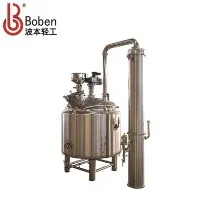
When building a single malt whisky distillery, one should not focus solely on the capacity, material and price of copper pot stills. While the still is the heart of the facility, a whisky distillery is a systematic engineering project. If supporting processes including malt handling, mashing, fermentation, double distillation, condensation & fractionation, spirit collection and storage, and equipment cleaning are not precisely matched, the whole production line can hardly consistently produce new make spirit with uniform flavour and qualified quality.
Complete Distillery: A Closed-Loop System Engineering Project
A standard single malt whisky distillery's core production system covers eight key process modules: malt handling, mashing, fermentation, double pot still distillation, condensation, fraction cutting, cask maturation, and equipment cleaning. It is also supported by utility systems and intelligent control systems to ensure regular production operation. If the project is planned for finished bottled whisky sales, additional full sets of equipment for blending, precision filtration, automated bottling, labelling and finished product packaging need to be installed, forming a complete closed loop from new make spirit production to finished goods delivery.
Front-End Processes: Malt Handling and Mashing – Laying a Solid Production Foundation
Malt handling is the first step in whisky production, mainly consisting of malt storage, milling and automated conveying. Small-scale distilleries may use bagged malt with manual feeding, while medium and large facilities are better suited for silos and conveying systems. Malt milling particle size is critical: overly fine grist easily causes filter blockages, whereas overly coarse grist reduces sugar extraction efficiency. The mashing system comprises a mash tun, lauter tun and hot water tank. Hot water supply, mashing and lautering capacity must be matched; otherwise batch output will be constrained.


Mid-Stream Processes: Fermentation, Double Pot Still Distillation and Condensation & Spirit Collection – Defining New Make Spirit Profile and Quality
The wort is cooled to the appropriate temperature before transferring to washbacks. Insufficient cooling leads to unstable fermentation and higher contamination risks. When selecting washbacks, tank volume alone is not enough; calculations must account for mashing batch size, fermentation cycle and distillation schedule. The double pot still system consists of a wash still, spirit still, steam heating system and associated piping & valves, strictly adopting the mainstream Scottish two-stage distillation process. The height and curvature of the swan neck, the inclination angle of the lyne arm, together with steam heating method and reflux performance, directly affect the retention and separation of flavour compounds. This is also the core factor creating whisky flavour differentiation between distilleries. The condensation and spirit collection system is fitted with key components such as condensers and a spirit safe, which are essential for accurate fraction cutting and directly determine new make spirit quality.


Back-End Processes: Storage & Maturation and Equipment Cleaning – Ensuring Spirit Stability
Freshly distilled new make spirit is temporarily stored first, then filled into oak casks for maturation. Maturation warehouses need to balance temperature & humidity control, ventilation, fire safety and room for long-term capacity expansion. Although the cleaning system is auxiliary equipment, it governs hygiene conditions, batch consistency and operational efficiency.


Infrastructure Support: Utilities and Automation – Sustaining Long-Term Stable Production
Utilities including steam, cooling water, power, compressed air, water supply & drainage, and wastewater treatment form the foundation for reliable distillery operation. Many project failures stem not from equipment defects, but from insufficient utility load capacity. Automatic control and testing equipment monitor parameters such as temperature, pressure, liquid level, alcohol strength and density, enabling standardized operations and traceable data records.
Bottling Line: Configure as Required and Reserve Room for Future Expansion
If only new make spirit or cask-matured whisky is produced in the early phase, the bottling line can be deferred, though space should be reserved within the building. If bottled finished products are to be sold, a bottling and packaging line shall be installed. Prior to procurement, confirmation is required on annual output, batch parameters, fermentation cycle, building conditions, utility capacity, maturation plan, budget and construction timeline.
Summary
Constructing a single malt whisky distillery hinges not on the selection and procurement of standalone copper pot stills, but on building an integrated system with matched capacity, streamlined workflows, controllable hygiene, stable long-run production and scalable expansion. Supported by the core double pot still distillation process, coordinated full workflows including front-end mashing & fermentation, mid-stream condensation & fraction cutting, back-end maturation & storage, alongside standardized, data-driven management systems, the distillery can continuously produce single malt whisky with authentic character and consistent quality. This represents the core philosophy behind modern professional malt distillery construction.