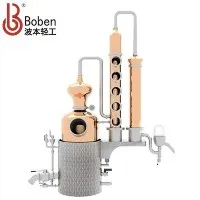
In the distillation of spirits such as whisky, the condenser not only determines whether alcoholic vapour can be fully cooled, but also directly affects copper contact, sulphide removal and the final character of new make spirit. Industry analysis reveals that worm tub condensers and shell-and-tube condensers differ substantially in effective copper contact, spirit profile, condensation capacity, installation footprint, cleaning & maintenance, and scalability. For most newly built commercial distilleries, shell-and-tube condensers represent the more reliable option; worm tub condensers, by contrast, suit projects that differentiate themselves through traditional craft and a heavy spirit character.
Operating Principle: Coil-in-tank vs Shell-and-tube Heat Exchange
A worm tub condenser consists of a single continuous coiled copper pipe submerged in a cooling water tank. Vapour travels inside the copper tube, transferring heat through the tube wall to the surrounding cooling water and gradually condensing into liquid. Its performance is governed by coil length, tube diameter, gradient, water temperature and flow direction. A shell-and-tube condenser comprises a shell and a bundle of heat-exchange tubes. Vapour and cooling water flow separately through the shell side and tube side without direct mixing, exchanging heat across the metal tube walls. Multiple tube bundles deliver a large heat transfer area within a compact footprint, making this design better suited to handling high vapour loads.


Copper Contact: Governing Spirit Body and Sulphide Retention
Copper facilitates the conversion and removal of sulphur-containing compounds. Shell-and-tube condensers deliver far greater copper contact - estimates put this at roughly 20 times that of worm tubs. New make spirit produced with worm tubs typically contains only around one quarter of the copper found in spirit from shell-and-tube setups. As a result, worm tubs tend to retain more cereal notes, meaty aromas, oily texture and sulphuric character, yielding a heavier, richer spirit. Shell-and-tube condensers, meanwhile, more readily produce clean, light new make spirit with prominent fruity notes.

Efficiency and Maintenance: Shell-and-tube Holds Clear Advantages
Shell-and-tube condensers excel in condensation performance and operational upkeep. Their large heat transfer area delivers stable condensation capacity, and they can be engineered to match the still's maximum heat load with built-in safety margin. The compact construction can reduce equipment volume by 40–60% versus traditional alternatives, suiting indoor installation. Tube bundles can be pulled out for cleaning, compatible with chemical cleaning and high-pressure water jetting. Leak detection is simpler, cutting maintenance time by approximately 70% and annual maintenance costs by about 40%. Worm tubs, by comparison, are bulky, consume roughly three times the metal of shell-and-tube units, and are far harder to clean, inspect for leaks and repair, alongside higher water consumption.


Heat Recovery and Capacity Expansion: Commercial Distilleries Favour Shell-and-tube
Shell-and-tube condensers integrate easily with heat recovery systems, achieving heat recovery rates up to 70%, and as high as 95% in alcohol distillation systems. Their modular design enables heat transfer area scaling from 10 m² to 1000 m², with shorter construction timelines. Worm tubs have limited heat recovery potential and usually require full replacement to increase production capacity. Industry data shows approximately 95% of new distilleries select shell-and-tube condensers for superior energy efficiency, smaller footprint and flexible scaling. Distilleries including Mortlach, Cragganmore, Talisker and Old Pulteney have retained worm tubs, which have become part of their brand heritage and flavour identity.
Selection Logic: Secure Full Condensation First, Then Shape Flavour
Industry consensus holds that a condenser must first fully handle all vapour generated under the still's maximum heat load. Flavour variations only matter when complete, safe and stable condensation is guaranteed. Rising energy costs, stricter environmental regulations and growing capacity requirements will continue to make shell-and-tube condensers the dominant choice for new commercial distilleries. Worm tubs will maintain a niche position in craft and traditional whisky production. The core of condenser selection is not simple substitution: ensure condensation integrity first, then align hardware with your spirit profile strategy.