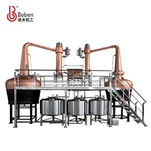
As many know, during the distillation of whisky, the copper in the pot still reacts with sulfur compounds in the spirit. This reaction naturally causes a gradual loss of copper from the still. Additionally, to avoid unpleasant burnt flavors caused by scorching during distillation, the interior of the still must be cleaned regularly. During cleaning, scrapers remove some of the copper. It's evident that the copper in the still is continuously being consumed, much like an iron wok used for cooking – over time, it becomes too thin, leading to easier scorching or even direct damage. Therefore, a still has a limited service life and must be replaced promptly when it can no longer meet distillation requirements.
A retired still from Yamazaki Distillery, placed on the grounds

So, how long does a still actually last?
Generally speaking, the lifespan of a still is approximately 20 to 30 years, though some may last as little as around 15 years, while others can exceed 50 years.
Why is there such a big difference in the lifespan of whisky pot stills? The service life of a still is influenced by factors such as frequency of use, maintenance practices, and the heating method.
The impact of usage frequency is straightforward: more frequent use leads to greater copper loss, which affects the still's lifespan.
The effect of maintenance is also easy to understand. Just like with our cookware, proper care can significantly extend its usable life.
The influence of the heating method might be less obvious. Why would the heating method affect the still's lifespan? As mentioned before, early whisky production used direct firing. After the 1960s, indirect heating gradually replaced direct firing as the mainstream method. One of the main reasons for this shift was to prevent scorching. Less scorching reduces the frequency of cleaning the still's bottom, which naturally decreases copper loss. Therefore, indirect heating can significantly extend a still's lifespan.
This reminds me of an iron wok my family used to have. According to my parents, they bought it before I was born. It was thick, durable, and served us for about twenty years without any noticeable change. Later, however, we switched to using coal for heating. Within a couple of years, I suddenly noticed we had a new wok. My parents told me the old one had burned through. In the terms of the whisky industry, that iron wok was used over direct fire. Even with the same direct heating method, simply changing the fuel from wood to coal drastically reduced the wok's lifespan. Later, when I started cooking myself, I clearly observed that cookware used on induction stovetops lasts significantly longer than that used on gas burners. This really highlights how much the heating method can impact lifespan, whether for a wok or a still.
Before I learned much about the whisky industry, I assumed the biggest consumable would be oak barrels, being made of wood and presumably less durable than metal stills. But the more I learned, the more I realized that in the whisky industry, an oak barrel can easily be used for over half a century, while a still might not necessarily last that long. Of course, once filled with whisky, oak barrels are stored in warehouses and rarely moved, whereas distillery stills are used for daily distillation. Their frequency of use is simply not comparable, so lifespan can't be judged by material alone.