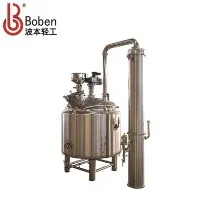
In this section, we will talk about the stills of the world's distilled spirits, that is, distillation devices.
1. Alcohol stills. The current principle of distilled spirits borrows the principle of alcohol distillation in many places, and the most complicated still is also an alcohol still. Alcohol stills are generally multi-stage towers, the simplest is a three-stage tower, and most are eight-stage towers. There are also many stages of trays in each distillation tower. The function of removing impurities" extracts various non-ethanol components. Generally, the trays in the distillation column have dozens of stages, and many hundreds of stages. At present, the common alcohol distillation device is a six-stage tower, as shown in Figure 1 is the six-column differential pressure distillation system of the Artheney alcohol factory in France. Let’s start with the mash tower. Generally speaking, the mash tower is the tower with the largest diameter, and the fermented and mature liquor (also called wine mash) is placed in it; there is a distillation section above the mash tower, the mash tower and the distillation section. It is regarded as two towers; after the wine comes out of the mash tower, it needs to be rectified, and the rectification tower will distinguish the different substances in it; then it enters the water extraction tower, which is the extraction tower of fusel oil. It is called the impurity removal tower, and the alcohol is extracted by the water extraction method, and the fusel oil is left; the last tower is the methanol removal tower. The fusel oil is more difficult to handle, and there are two towers dedicated to removing the fusel oil. The eight-column process (as shown in Figure ②) has an additional one-stage distillation column and one-stage water extraction column. In the alcohol industry, except for alcohol, other impurities are by-products, and by-products also have economic value. In addition to the production of alcohol, there are currently more than 200 by-products extracted. The spirits in the world that are similar to alcohol are vodka, which also adopts tower distillation. The Laizhou Distillery in Qionglai, Sichuan, China, has an eight-tower device for vodka distillation. The difference between vodka and the alcohol industry is that the vodka device is relatively small, and the large-scale alcohol factory with a production capacity of more than 100,000 tons has a much larger distillation tower.
2. Whiskey pot still. Unlike Chinese liquor, all whiskeys are fractionally distilled. Most whisky distillation devices have two stages. The first stage is called the wine still, which is equivalent to the mash tower in the alcohol distillation device. The original fermentation is placed inside. Wine juice, the alcohol concentration in wine juice is about 12%. Primary distillation can't increase the alcohol concentration much, it can only increase the alcohol concentration to about 20%, and then put the distilled solution into another secondary still called a spirits still for further distillation, in order to obtain a concentration of 80%. An aqueous solution with an alcohol concentration above %, that is, wine. Unlike alcohol removal devices, whisky has to retain those complex components, which are so-called "impurities" in the alcohol industry. Judging from the shape of the pot distillation device, it has a reflux function, and whether it is an onion-shaped still or a pear-shaped still has a reflux function, which can remove impurities considered in the alcohol industry: acids, esters, aldehydes, alcohols, etc. Keep it to prevent it from evaporating with the alcohol. Whiskey stills are mainly made of copper. The whisky industry believes that copper has a catalytic effect, and stills made of copper and stainless steel have different effects. The aroma of wine produced by stainless steel stills tends to be "meaty", while the aroma of wine produced by copper stills is more fruity and grassy. At present, whisky manufacturers mainly use copper pot stills, and there are also column stills that are different from pot stills.
3. Chinese liquor distiller. The distiller for Chinese liquor is called a wine retort, which can be large or small. Generally, the upper diameter is 2m, the lower diameter is 1m, and the height is about 1m. The condensing device used above was the sky pot condensation, and now most of them have been changed to straight-tube condensers. There is a process of evolution about the characteristics and principles of wine retorts, which will be explained later. It should be emphasized here that compared with whisky stills, the efficiency of wine retorts for Chinese liquor is very high, and the alcohol concentration can be as high as 75% in one distillation. % wine, and without the need for precise control of reflux, it can also bring out complex material components, more than whisky. Whiskey is liquid fermentation and liquid distillation; Chinese liquor is solid fermentation and solid distillation. Compared with the liquid state, solid-state fermentation has obvious phase interface effect, and under the action of high-temperature steam, a reaction will occur during the distillation process, which will produce aroma and taste substances that are not present in the fermentation process. This is a Chinese liquor distiller liquor. The retort advantage. The wine retort has not changed much after hundreds of years, because it has irreplaceable advantages.