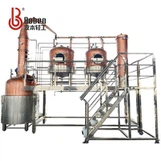
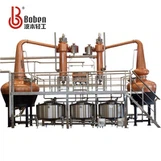
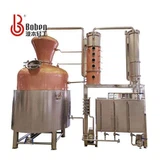
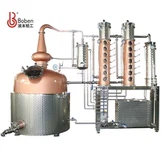
1.Capacity and Overall Design
Total Capacity: 150 liters. This is an ideal capacity for commercial entry-level or small-batch production.
Working Capacity: The typical single distillation charge (fermented wash) is approximately 100-120 liters, providing safe headspace for boiling and foaming.
Construction Material:
Main Body: Made from food-grade 304 (or higher-grade 316L) stainless steel and copper, ensuring corrosion resistance, no off-flavors, ease of cleaning, and compliance with food safety standards.
Key Components: Critical contact parts such as the column interior, condenser, and flavor basket are often made of high-quality, thick-gauge copper. Copper effectively absorbs undesirable impurities (e.g., sulfides) during distillation, catalyzes chemical reactions, and contributes to a purer, smoother spirit with the distinctive flavor profile characteristic of traditional liquors.
Design Style: Features a modular design. Components (e.g., kettle, column, condenser, flavor basket) are connected via sanitary quick-clamp fittings, enabling easy disassembly, installation, and cleaning. The exterior can be polished, sandblasted, or mirror-finished for a professional and aesthetically pleasing appearance.
2. Heating System
Heating Methods: Multiple options are available to suit different sites and needs:
Internal Electric Heating Elements: The most common and convenient method. Heating elements are typically located at the bottom of the kettle, sheathed in stainless steel, with adjustable power.
Steam Heating: A more professional option. Requires an external steam generator (boiler). The kettle is designed with a steam jacket or an internal steam coil. Steam heating provides large, even, and gentle heat transfer, effectively preventing scorching, especially when distilling grain mashes.
External Gas or Oil Heating: Less common but used in certain traditional processes or specific regions.
Power: Highly customizable.
For electric heating, the total power typically ranges from 18kW to 36kW. For example, it can be configured with 2 × 9kW (total 18kW) or 3 × 12kW (total 36kW) heating elements, supporting step control (e.g., 9kW/18kW/27kW/36kW) for precise adjustment of heating rate and boiling intensity.
The power selection depends on the user's electrical supply (e.g., three-phase power) and desired heating speed.
3. Power Supply and Control System
Voltage: Fully customizable to adapt to standards in different regions worldwide.
Common configurations include: 220V single-phase (for lower power, e.g., ≤12kW, suitable for household use), 380V/400V three-phase (industrial standard, for higher power, e.g., 18kW–36kW, highly recommended for commercial use), 440V or other specific industrial voltages.
Users must select the voltage based on their local grid conditions and the chosen power.
Control System:
Intelligent PLC Touchscreen Control System: A standard feature in modern stills. A color touchscreen displays all critical parameters.
Control Functions: Allows precise setting and real-time monitoring of temperature (kettle, column, heads/hearts/tails outlet temperature), heating power percentage, timer, etc.
Automation: Supports pre-set distillation curves; the system automatically adjusts power to maintain stable output. Automatically records distillation data for traceability and quality control.
Safety Protection: Integrates multiple safety features, including automatic over-temperature shutdown, dry-fire protection, leakage protection, and over-pressure safety valves.
4. Column and Condenser
Column:
Type: Typically a multi-plate column (e.g., 3–5 plates). The number of plates affects separation efficiency and final alcohol proof. Can also be configured with packing material for more refined purification.
Height and Diameter: Dimensions are optimized for effective fractionation. Height and diameter can be customized based on customer preferences for efficiency versus speed.
Sight Glasses: Often equipped with glass sight glasses on the column to monitor internal boiling and reflux.
Condenser:
Type: Primarily uses highly efficient shell and tube condensers, which offer a large cooling surface area for excellent condensation.
Cooling Method: Water-cooled. Requires connection to a cooling water circulation system (e.g., a chiller or cooling tower).
Material: Condenser tubes are typically made of copper or stainless steel.
5. Other Features and Accessories
Flavor Basket: Located in the upper part of the column, used for holding juniper berries, botanicals, etc., specifically for crafting Gin or other flavored spirits.
Cleaning Manhole: A large opening on the top of the kettle allows operators to access the interior for thorough cleaning and inspection.
Thermometer Wells: Multiple ports are reserved for temperature sensors.
Sample Valve: Allows drawing samples during distillation for testing.
Alcometer Holder: Holds an alcometer to monitor the alcohol proof of the output in real-time (requires temperature compensation).